Most homeowners reach for whatever tool is on sale when fall hits. That works fine until you spend a Saturday emptying a hopper every ten minutes, or realize your vacuum mulcher can’t handle the pine needles covering half your yard. A leaf vacuum mulcher and a lawn sweeper both eliminate raking, but the right choice depends on your yard’s size, tree types, and what you actually plan to do with the leaves once they’re off the ground.

How Each Tool Collects Leaves and Yard Debris
A lawn sweeper uses rotating brushes driven by wheel motion. As you push or tow it across the lawn, the brushes spin against the ground and fling debris upward into a collection hopper. Push models require no power source at all. Tow-behind models attach to a riding mower and cover more ground per pass, with hopper capacities that can exceed 22 cubic feet. One spec worth paying attention to when buying is the brush-to-wheel ratio: a higher ratio means more brush rotations per wheel turn, which translates to better pickup on each pass, especially for finer debris.
A leaf vacuum mulcher works through suction and shredding. A motor pulls air through a wide intake tube, drawing leaves in. Inside, a metal impeller blade cuts them into fine mulch before depositing the output into a collection bag. Most vacuum leaf mulcher units reduce leaf volume by 10:1 or more, so ten bags of whole leaves become one bag of shredded material ready for compost or garden beds. These units come in three power types: corded electric, battery-powered, and gas. Corded models are the lightest and easiest to maintain. Battery models offer mobility without a cord but have runtime limits per charge. Gas models handle the heaviest leaf loads without stopping, though they require more maintenance and produce significantly more noise.
When a Lawn Sweeper Works Better
Lawn sweepers perform best on large, flat, open lawns. If you have half an acre or more and already own a riding mower, a tow-behind sweeper clears the yard in fewer passes without requiring you to manage power or charge a battery. Hopper capacity handles higher debris volume before you need to stop and empty.
They’re also the quieter option. Push sweepers produce almost no noise, which matters if you’re working early in the morning or in a neighborhood with noise restrictions. A leaf vacuum mulcher, especially a gas model, runs at blower-level volume.
For post-mow grass clipping cleanup, a push sweeper is hard to beat in efficiency. There’s no setup, no charging, and almost no mechanical maintenance. Check the brushes for wear once a season, and that’s the extent of it.
One firm limitation: lawn sweepers need dry conditions. Wet leaves mat flat against the grass, and the brushes can’t lift them cleanly into the hopper. Wait for a dry afternoon before sweeping after rain.
When a Leaf Vacuum Mulcher Is the Better Choice
The clearest reason to use a leaf vacuum mulcher is what happens to the leaves after collection. A sweeper dumps whole, uncompressed leaves into a hopper: bulky, unprocessed, and still requiring separate disposal. A leaf vacuum and mulcher shreds as it collects, producing material you can put directly into a compost bin or spread over garden beds. At a 10:1 compression ratio, you’re also emptying the bag far less often for the same volume of leaves.
For smaller yards and non-grass surfaces, the leaf vacuum mulcher handles what a sweeper can’t reach. Handheld and backpack models work around flower beds, along fence lines, on patios, driveways, and against walls. A push sweeper needs open, flat ground and misses anything in corners or on raised surfaces.
Most leaf vacuum mulcher units also switch between blowing, vacuuming, and mulching modes, making them useful beyond fall cleanup. A lawn sweeper does one thing only.
Yards with heavy deciduous tree coverage benefit most. Shredded leaves break down in compost significantly faster than whole leaves, which can mat into dense layers that resist decomposition for months. If you’re putting leaves to work in garden beds or a compost pile, a vacuum leaf mulcher saves you a processing step that the sweeper simply skips over.
Compare Wet Leaves, Pine Needles, Acorns, and Grass Clippings
Debris type changes, which tool performs better, and in some cases, neither option is ideal.
Wet leaves are difficult for both. Sweeper brushes can’t grip leaves stuck flat against wet grass. A leaf vacuum and mulcher has better suction, but wet leaves clump and can jam the impeller. Either way, dry conditions produce far better results for both tools.
Pine needles favor the leaf vacuum mulcher. Needles are thin, flat, and slippery, and rotating brushes struggle to catch them consistently. Adjusting the sweeper brush height lower helps, but pickup is still unreliable. Suction-based collection doesn’t depend on physical contact, so a vacuum pulls needles in more consistently.
Acorns favor the sweeper. Dense, round, and heavy, they move cleanly through brush-based collection. A leaf vacuum mulcher can pick them up, but acorns risk jamming the impeller on standard residential models. If your yard drops heavy acorn loads every fall, a sweeper or a heavy-duty vacuum rated for dense debris is the better fit.
Grass clippings are the sweeper’s strongest use case. Dry, uniform, and plentiful after a mow, they sweep up efficiently in one pass. A vacuum leaf mulcher handles clippings but takes longer and runs louder for a task that doesn’t require mulching.
Storage, Maintenance, and Cleanup Time Matter More Than Size Alone
Lawn sweepers require almost no mechanical upkeep. No motor, no fuel, no battery management. At the end of the season, check the brushes for wear and inspect the hopper seams. Brush replacement is the only recurring cost, and it’s infrequent. The main downside is storage: tow-behind models are wide, awkward to collapse, and take up real garage space. If you’re tight on storage, a push sweeper is more manageable, though it covers less ground per pass.
Leaf vacuum mulchers need more regular attention during and after the season. Clear the intake tube and impeller housing after each use to prevent clogging and corrosion from trapped moisture. At season’s end, steps vary by power type. Gas models require a fuel stabilizer added to the tank before storage, and the carburetor should be inspected before the first spring use. Battery models should be stored at 40–60% charge in a dry location away from temperature extremes — storing a fully depleted lithium battery over winter shortens its lifespan. Corded electric models are the simplest to put away: wipe down the housing, clear the tube, and hang it up. Most handheld units fold compactly and take up far less space than a tow-behind sweeper.
On per-session cleanup time, the leaf vacuum mulcher wins on emptying frequency. A sweeper collects whole leaves, so the hopper fills faster for the same volume of ground covered. A 10:1 or 16:1 mulch ratio means significantly fewer stops per session with a vacuum mulcher, which adds up noticeably on a heavy leaf day.
Choose the Leaf Cleanup Tool That Fits Your Trees, Terrain, and Workload
Both tools have a clear home. The right one depends on how you use your yard, not just how big it is.
A lawn sweeper fits your yard if:
- You have a large, flat lawn and already own a riding mower
- Quiet operation matters for your neighborhood or schedule
- Your main debris is dry leaves and grass clippings after mowing
- You want minimal mechanical maintenance year over year
A leaf vacuum mulcher fits your yard if:
- You want to convert leaves into mulch or compost directly
- Your yard includes patios, beds, fences, or hard surfaces alongside grass
- Pine trees are a significant part of your landscape
- Compact storage and multi-function use across seasons matter
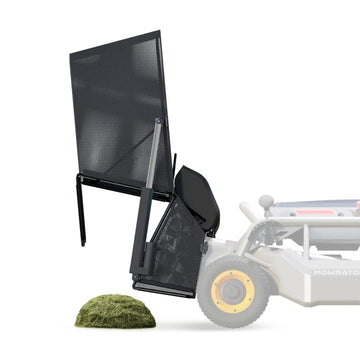
Both tools work well on accessible, flat ground. On slopes, in tight terrain, or in areas that are physically difficult to maneuver in, the physical effort required by either tool increases significantly. The Mowrator S1 Leaf & Lawn is built for exactly those conditions. It is a remote-controlled electric mower that combines mowing, mulching, bagging, and a dedicated leaf vacuum mode with 931.55 CFM of suction, operable from a distance on slopes up to 119% grade (50°). For standard yards, the sweeper or the leaf vacuum mulcher handles the job. For terrain that makes either of those tools impractical, a purpose-built machine is worth considering.
FAQs about Leaf Cleanup Tools
Q1. Can a Lawn Sweeper Pick Up Matted or Wet Leaves?
No, not reliably. Wet or matted leaves press flat against the grass, and the brushes can’t get underneath to lift them. For matted debris, a leaf vacuum mulcher with strong suction performs more consistently since airflow doesn’t depend on contact with the surface.
Q2. Does a Leaf Vacuum Mulcher Work on Gravel?
No. Suction will pull small stones in along with leaves, which damages or destroys the metal impeller blade. On gravel surfaces, use a blower to move debris onto a non-gravel area first, then vacuum from there.
Q3. How Often Should You Empty a Leaf Vacuum Mulcher Bag?
Empty it at around 75% capacity. A full bag reduces suction and forces the motor to work harder. With a 10:1 mulch ratio, a 10-gallon bag holds the equivalent of roughly 100 gallons of uncompressed leaves before needing to be emptied.
Q4. Is a Push Lawn Sweeper Effective on Uneven Terrain?
Only on mild variation. Significant bumps or inclines cause the hopper to shift and the brushes to lose ground contact, leaving patchy pickup. Tow-behind models handle moderate unevenness slightly better due to a wider wheel base, but neither type performs reliably on hilly ground.
Q5. Can You Use a Leaf Vacuum Mulcher Outside of Fall?
Yes. In spring, a leaf vacuum and mulcher handles seed pods, catkins, and winter debris effectively. It also works on dried grass clippings in garden beds and hard surfaces throughout the growing season. The compression ratio makes off-season cleanup fast. A small volume of shredded material is far easier to compost or dispose of than bags of whole debris.