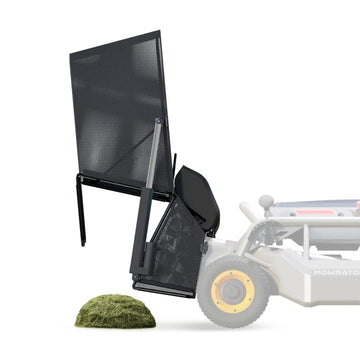
A remote control mower usually runs about $1,500 to $5,000 for homeowner-focused equipment, while heavy-duty slope models can pass $8,000. Your final remote control mower price tracks with cutting power, battery capacity, traction, safety systems, and included attachments.

What Price Range Should Homeowners Expect?
| Mower Category | Typical Price Range | Common Use |
|---|---|---|
| DIY conversion parts | $500 to $2,000 | Hobby projects and custom builds |
| Entry-level ready-made mower | $1,500 to $3,000 | Smaller lawns and moderate grades |
| Higher-capacity residential mower | $3,000 to $5,000 | Larger lawns, tall grass, slopes, and rough ground |
| Heavy-duty slope mower | $5,000 to $8,000 or more | Steep banks, brush, and demanding property care |
| Commercial tracked equipment | $10,000 to $40,000 or more | Daily contractor, municipal, or land management work |
Prices shift with promotions, battery options, attachments, freight, and dealer support. A listing that looks inexpensive may cover the mower alone, while a higher package price may include a larger battery, grass collection equipment, wider tires, or an automatic dumping system.
Compare the complete delivered package whenever you review a remote control lawn mower for sale: mower, battery, charger, controller, required attachments and accessories, shipping, and setup costs.
Why Do Remote Mowers Cost More Than Push Mowers?
A push mower receives forward force from you. An RC mower relies on drive motors, motor controllers, gearboxes, traction hardware, and a radio system to move and steer. A four-wheel drive layout adds more powered components along with more control on slopes.
The structure carries extra loads too. Motor torque, battery weight, side slope force, and frequent direction changes all place demands on the frame and deck, so higher-priced units tend to use stronger frames, protected electronics, and serviceable drive parts.
Electric platforms also keep exhaust away from the point of use. The EPA sets both exhaust and evaporative emission standards for small gas engines used in lawn equipment, and a battery machine sidesteps both during operation — worth real money at homes where noise, fuel storage, and fumes near living areas matter.
Which Features Affect Mower Price?
| Feature | How It Changes Cost | What You Gain |
|---|---|---|
| Cutting motor output | Larger motors and control electronics add cost | Better blade speed in thick grass and heavy leaf loads |
| Battery capacity | More cells and a stronger management system raise the price | Longer runtime and more area per charge |
| Two-wheel or four-wheel drive | Four-wheel drive requires more motors and drive parts | Added traction and steering control on demanding ground |
| Tires and ground clearance | Specialized tires and stronger hubs add cost | Better grip and obstacle crossing |
| Remote control system | Low-latency controls and signal protection add hardware | Faster response and more precise movement |
| Safety sensors | Tilt, collision, and lift detection require extra components | More ways to stop or restrict unsafe operation |
| Collection attachments | Powered collection and dumping add motors and structure | Less manual handling of clippings and leaves |
Amp hours alone give an incomplete picture of battery value, since voltage, motor load, grass density, travel speed, and cutting height all shape runtime. Compare rated mowing time and area per charge instead. A 56V 18Ah pack on the Mowrator S1 delivers roughly 2 hours 15 minutes across up to 1.125 acres, while the 12Ah pack runs about 1 hour 30 minutes across up to 0.75 acres.
Safety hardware carries real value as well. The federal safety standard for walk-behind power lawn mowers requires a blade control system that keeps the blade still until the operator actuates the control and demands continuous contact for it to keep turning. On an RC model, check the emergency stop, blade shutoff, signal loss response, tilt protection, and obstacle sensing. The Mowrator S1 Leaf & Lawn 4WD shows how those pieces stack up in price: a 21-inch deck, 1985.6W peak cutting power, grip tread tires, 10 cm of obstacle clearance, ultrasonic detection, blade auto-stop, and tilt sensing sit well above a basic flat yard machine.
How Does Your Yard Affect Value?
Your yard sets the value through the amount of difficult work a mower handles per season.
- Area and runtime: Larger lawns favor longer runtime, efficient travel speed, and batteries that finish major sections per charge.
- Slope: A gentle grade may suit a two-wheel drive mower rated for 45% slopes, while steep banks are where a 119% slope 4WD configuration earns its price through traction, weight balance, and braking control.
- Surface and access: Ruts, roots, gravel, drainage channels, trees, and narrow passages call for ground clearance, durable tires, and predictable stopping.
- Grass condition: Dense weeds, wet growth, and heavy leaves require stronger cutting performance and effective deck airflow.
- Seasonal jobs: Mulching, bagging, leaf vacuuming, towing, or snow work spread the same purchase across more months.
Measure the steepest zone with a digital level and record both degrees and percent grade, since those units sit on different scales and a direct label comparison prevents a costly mismatch. Extra traction and capacity pay off where hills, high grass, or large acreage would otherwise call for a second machine or paid labor.
DIY RC Mower Kits Compared With Ready-Made Machines
| Buying Factor | DIY RC Mower Kit | Ready-Made RC Mower |
|---|---|---|
| Upfront cost | Often lower for parts | Higher complete purchase price |
| Assembly | Fabrication, wiring, programming, and testing | Limited setup |
| Design freedom | High | Defined product configuration |
| Safety integration | Builder validates each system | Integrated controls and tested design |
| Parts matching | Requires technical research | Matched battery, charger, motors, controller |
| Support | Community or supplier help | Product support and written warranty |
| Time to use | Depends on build complexity | Often ready after basic assembly |
A kit price represents parts alone. Fabrication time, test equipment, and troubleshooting add the rest, and the build sits outside the compliance process that covers retail machines: manufacturers and importers of walk-behind power mowers issue a General Certificate of Conformity and apply a compliance label tied to CPSC blade safety requirements.
Ready-made equipment places compatible systems into one purchase with written warranty terms behind them. The FTC advises weighing coverage against hidden costs such as deductibles and return shipping when reviewing warranties and service contracts. Mowrator covers the main machine, remote control, and battery for two years and accepts returns within 30 days.
Pick a kit when fabrication forms part of the goal. Pick a ready-made mower when dependable seasonal use and integrated safety controls carry greater weight.
How Should You Choose an RC Mower?
- Map the hard zones. Record lawn size, steep areas, narrow access points, soft ground, and spots with heavy leaves or tall growth, then set minimums for slope rating, drive type, cutting width, runtime, and ground clearance.
- Compare complete packages. As you review a remote control mower for sale or an RC lawn mower for sale, check what arrives in the box — batteries, chargers, tires, bags, and freight all change the real total.
- Check safety controls. Look for a clear emergency stop, quick blade shutdown, defined signal loss behavior, and a safe startup sequence.
- Review service access. Confirm parts availability, repair options, and return terms. For Mowrator owners, we provide a product manual library, troubleshooting resources, and ownership FAQs, along with repair locations in California and Missouri.
- Count what the mower replaces. List the hired service, the second machine, or the seasonal cleanup the purchase takes off your hands.
Search results for remote-controlled lawn mowers for sale mix small robotic units, residential RC machines, and commercial tracked equipment, so filter by control type, terrain rating, and included equipment before comparing prices.
Compare Remote Control Mower Prices and Match One to Your Yard
Write down three numbers first: the steepest grade on your property in percent, your total mowing area, and the seasonal jobs you want covered. Then match those figures to a build. The 2WD S1 handles standard lawns and gentle grades, the 4WD S1 takes on 75% slopes and tall grass, and the 119% slope build covers steep banks and rough ground. Check the delivered package, battery capacity, and warranty on each product page, then send your measurements to the Mowrator team for a configuration check before you order.
FAQs About RC Lawn Mower Use
Q1: Do Remote Control Lawn Mowers Need Boundary Wires?
No. Manually operated remote control mowers follow commands from a handheld controller, so boundary wire installation is usually unnecessary. Autonomous robot mowers may rely on perimeter wires, GPS, RTK positioning, or cameras. Check the control method before purchase, since listings sometimes place both types in one category.
Q2: Can You Use a Remote Control Lawn Mower in Rain?
Only where the product manual permits it. Water resistance ratings vary across the mower, battery, controller, and charger, and wet slopes reduce tire grip while lengthening stopping distance. Pause work during lightning, standing water, or poor visibility, and let wet grass dry once clumping starts to block the deck.
Q3: How Should You Store an RC Mower Battery?
Keep the battery in a cool, dry area away from direct sun, freezing conditions, heat sources, and flammable material, following the charge level and inspection schedule in the product manual. Check for swelling, cracks, leaks, or unusual heat before charging. The U.S. Fire Administration's battery fire safety advice points to room temperature storage where possible, with charging kept above 32°F and below 105°F.
Q4: Can You Transport an RC Lawn Mower in an SUV?
Yes, provided the mower fits the vehicle's cargo limits and stays secured against movement. Measure folded dimensions and weight before purchase, remove or isolate the battery as the manual directs, empty loose clippings, and use rated tie-down points. A ramp helps with heavier units when its load rating covers the mower.